Why Online Stores Need AI in 2026
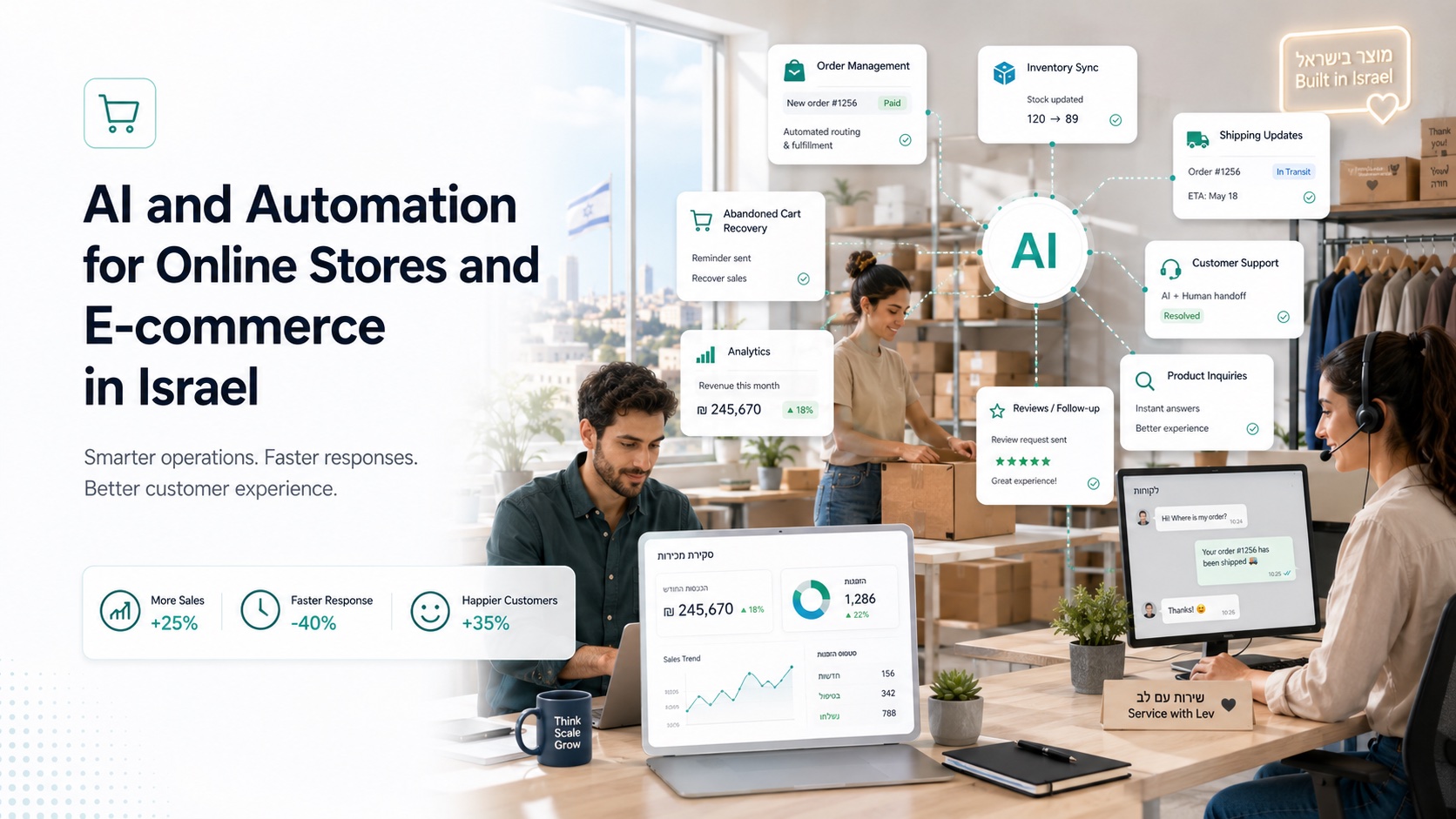
Israeli e-commerce is growing fast, but most stores still handle customer service manually. While according to CBS Israel data (04/2026), 39% of businesses in Israel already integrate AI, the share is still low in local e-commerce — and that’s a meaningful competitive factor in a world where customers expect instant response.
The Four Stages Automation Upgrades in E-commerce
1. Pre-purchase Stage — Questions and Hesitations
A customer interested in a product wants to know: size, material, shipping time, return policy. With no instant response — they move to a competitor. 70% of journey drop-offs happen here (market estimate).
Our AI agent, connected to your catalog and policies, answers instantly. See AI agent for business for the full explanation.
2. Purchase Stage — Abandoned Carts
The average cart abandonment rate in e-commerce is 65–75% (source: providers). WhatsApp automation sends a reminder at the right time:
- 1–2 hours after abandonment — first reminder
- 24 hours after abandonment — second reminder with a small offer (free shipping, 5% off)
- 72 hours — final offer before the cart closes
Recovering 5–15% of abandoned carts = a direct revenue lift (estimate).
3. Post-purchase — Status and Updates
Customers ask “Where’s my order?” again and again. Instead of a manual response:
- Automatic notification when the order ships, when it arrives at the distribution center, when it goes out for delivery
- Automatic answer to every “where?” question based on tracking data
This is both an experience improvement and a service-cost reduction.
4. Post-delivery — Service, Returns, Cross-sell
- Short satisfaction survey 7 days later
- Automated returns process — reason, approval, RMA code, shipping instructions
- Complementary product suggestion — not spam, but one focused recommendation based on purchase history
The Technical Integration
We connect the agent directly to Shopify, WooCommerce, or your platform via the official API. The flow:
Customer asks on WhatsApp
 ↓
AI agent receives the message (via Meta Cloud API)
 ↓
Identifies the customer by phone → pulls orders from Shopify
 ↓
Returns a contextual answer (status, items, next steps)
 ↓
Logs the interaction in the CRM
See the WhatsApp automation service and CRM implementation for additional technical detail.
Illustrative Scenario — Fashion Online Store (Hypothetical)
An Israeli fashion store with 500 orders per month, a service team of 2. Illustrative scenario before automation:
- 200 service inquiries per month (status, returns, questions)
- The team barely keeps up, average response time: 4 hours
- ~30% cart abandonment, no follow-up
- Repeat-purchase rate: ~22%
Illustrative scenario after automation:
- 200 inquiries → AI agent handles 160 automatically, team handles 40 complex
- Average response time: 2 minutes
- Abandoned-cart automation recovers 8–12% of carts
- Repeat-purchase rate rises to ~28% (thanks to fast service + smart suggestions)
The numbers are a hypothetical model based on orders of magnitude in the e-commerce sector. Not a real case-study figure. We’ll provide verified cases after broader launch.
Why Autias for Your Store
- Deep integration with Shopify / WooCommerce / Wix Stores — not just “a bot that talks,” but an agent that pulls real-time data
- Support in 3 languages (HE/RU/EN) — important in stores with a diverse audience
- Meta Cloud API compliance — we don’t use “shortcuts” that endanger your business WhatsApp account
- Turnkey service — you get a working system, not DIY
See also:
- WhatsApp Cloud API — Guide
- DIY vs. Turnkey — When to Choose Each
- WhatsApp Business Automation in Israel
What’s Next
Book an initial consultation. A 30-minute call, no commitment. We’ll review your store, identify automation opportunities, and provide an initial ROI estimate.
Notes: Cart abandonment rates and revenue recovery are market estimates / models [С/Н]. Not a commercial offer. Outcomes in a specific business depend on category, demand, and campaign quality.