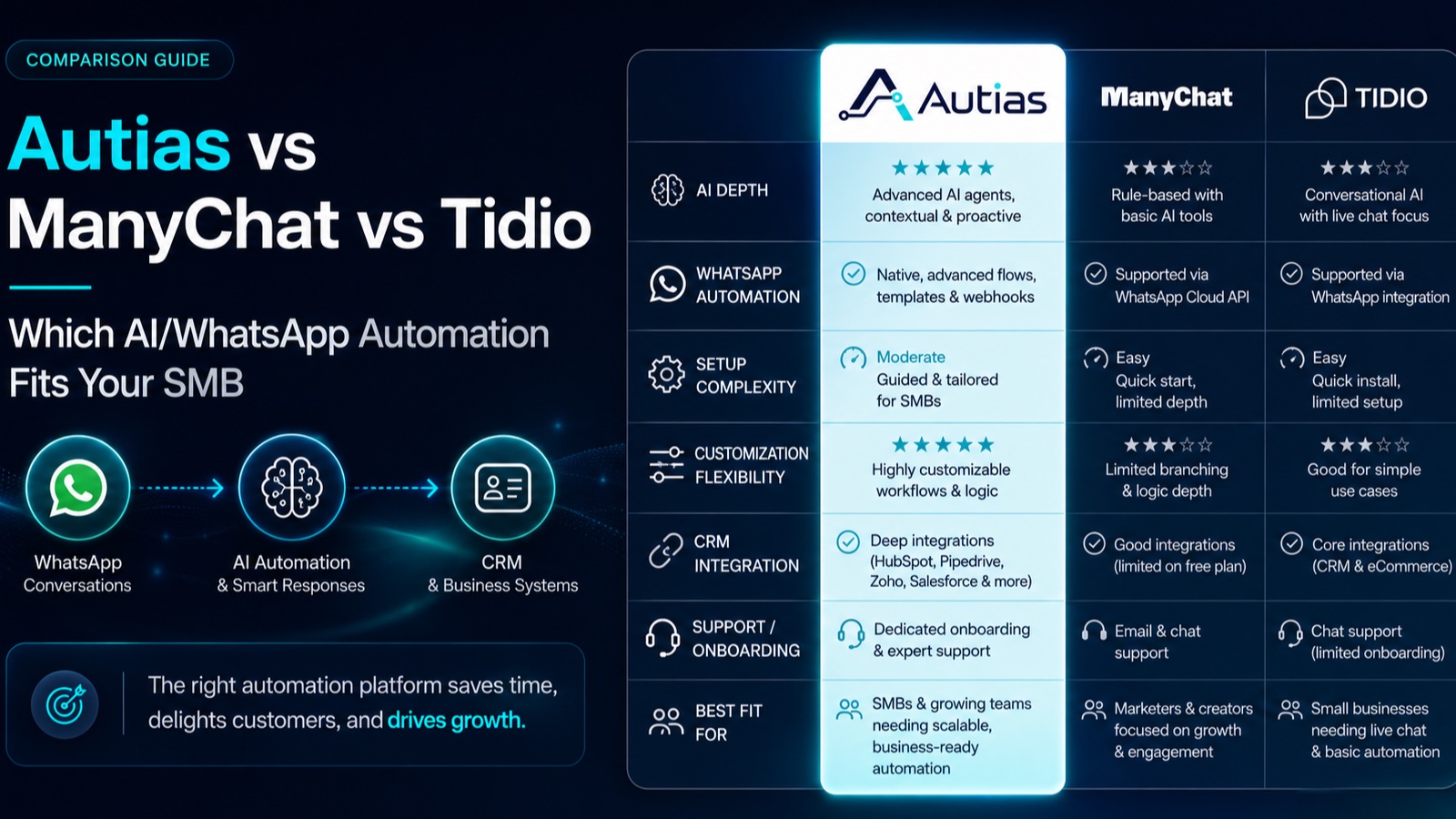
Autias vs ManyChat vs Tidio — Which AI/WhatsApp Automation Fits Your SMB
In 40 seconds: ManyChat ($15-150/mo) and Tidio ($29-749/mo) are excellent DIY templates for English-first, predictable decision trees. Autias is a turnkey custom agent (₪3-12K setup + ₪250-800/mo) trained on your knowledge base, with native Hebrew/RTL and direct integrations to Powerlink, Fireberry, monday and HubSpot. Pick by use case, not by sticker price.
TL;DR — Pick by job-to-be-done
- Pick ManyChat if: you run Instagram/Messenger marketing flows, your audience is English-speaking, and you’re happy building and maintaining the bot yourself.
- Pick Tidio if: you need a website live chat + AI FAQ deflection (Lyro) for a Shopify or WooCommerce store, English audience, omnichannel inbox is the must-have.
- Pick Autias if: your customers write to you in Hebrew, you need direct CRM writes (not Zapier), and you want someone else to own setup + maintenance with a fixed timeline.
- Avoid all three if: you do under 3-5 inquiries/day. The cheapest tier of any tool is still overhead you won’t recoup. Use a shared inbox + canned replies until volume justifies automation.
If you’re not sure where you land, book a 30-min demo — if ManyChat or Tidio is the right call we’ll say so and point you at the relevant setup guide.
If you’re shopping for WhatsApp automation or an AI chat agent, you’ve probably stumbled on ManyChat and Tidio — the two most-googled SaaS platforms in the category. You’ve also probably noticed that almost nothing in their documentation is in Hebrew, and that the demo bots feel like they were designed for a US e-commerce store, not for a Tel Aviv clinic or a Petah Tikva law firm.
We get asked the same question several times a week: “We saw ManyChat costs $15/month — why would we pay you ₪3,000?” It’s a fair question, and the honest answer is more interesting than the marketing one. This post lays out the comparison the way we’d want it laid out if we were on your side of the table.
We won’t trash competitors. ManyChat and Tidio are good products for the markets they were built for. The question is whether those markets include yours.
The big comparison table
| ManyChat | Tidio | Autias | |
|---|---|---|---|
| Pricing model | Per-contact SaaS subscription | Per-conversation SaaS subscription | Project setup + monthly retainer |
| Headline price | $15-$150/mo per channel | $29-$749/mo | ₪3,000-12,000 one-time + ₪250-800/mo |
| Setup | DIY visual builder (hours-days) | DIY builder + AI training (hours-days) | We build it (1-4 weeks) |
| NLU / Hebrew quality | Rule-based + AI Step (GPT) | Lyro (generic LLM) | Custom-trained on your Hebrew knowledge base |
| RTL support | Builder is LTR-only (Hebrew renders, but UX is awkward) | Builder is LTR-only (widget renders Hebrew fine) | RTL-first across admin, training and customer-facing |
| WhatsApp Business API | Yes (via Meta-approved BSP) | Yes (via Meta-approved BSP) | Yes (direct Cloud API integration) |
| CRM integrations | Native: Shopify, Meta. Rest via Zapier/Make | Native: Shopify, HubSpot, Salesforce. Rest via Zapier | Direct: Powerlink, Fireberry, monday.com, HubSpot, Pipedrive |
| Who maintains it | You | You | We do |
| Support hours / language | EN, async + chat on Premium | EN, chat 24/5 | HE/EN/RU, business hours, 2h SLA |
| Time to launch | Hours-days (if you know the tool) | Hours-days (if you know the tool) | 1-4 weeks fixed-scope |
All pricing as of 05/2026. Check vendor pricing pages for the current tier — SaaS tiers shift often.
When ManyChat is the right call
ManyChat is, at its core, a flow builder for messaging channels — Messenger, Instagram, WhatsApp, SMS, email. Its strength is broadcast marketing and structured flows: drip campaigns, comment-to-DM triggers on Instagram, abandoned-cart sequences for Shopify stores. If your business model is “reach English-speaking customers on Instagram or Messenger and push them through a marketing funnel,” ManyChat is genuinely excellent at it — and at $15-$150/month per channel, it’s one of the cheapest ways to do it.
The catch: ManyChat is rule-based first, AI second. Its “AI Step” feature (built on GPT) is real, but it sits on top of a flow-builder paradigm, not the other way around. You design the flow; the AI fills in the gaps. That’s fine for predictable scenarios — less fine for open-ended questions where you can’t pre-script the branches.
ManyChat is also English-first: the UI, the documentation, the community templates, and the AI training examples all assume English. It can technically handle Hebrew text (it’s Unicode like anything else), but the experience of building Hebrew flows in an LTR canvas where every text field expects English-ordered punctuation is, to put it gently, not the design target.
Buy ManyChat if: you’re an Instagram/Messenger-led brand, your audience is English, your flows are mostly broadcasts and structured triggers, and you have someone in-house who enjoys building flow logic.
When Tidio is the right call
Tidio started as a website live chat tool and grew into a chatbot + helpdesk hybrid. Its strength is the small-business e-commerce niche: a Shopify or WooCommerce store that wants chat on the site, a chatbot for FAQ deflection, and a unified inbox combining email + Messenger + WhatsApp.
Tidio’s “Lyro” AI bot is its answer to the GPT wave, and it works decently for English FAQ deflection — Tidio publishes a typical resolution rate around 60% for well-trained Lyro deployments, which is in line with what we see industry-wide for FAQ scenarios. Pricing climbs steeply with conversation volume: starter plans are around $29/month, but anyone with real traffic ends up on the $59-$749/month range, and AI conversations are metered separately.
Tidio’s weak spot is the same as ManyChat’s: it was designed for an English-speaking SMB audience. Hebrew support exists at the customer-facing level (the chat widget displays Hebrew text correctly), but the agent training, the documentation, and the prompt engineering inside Lyro all assume English-language inputs. For a Hebrew clinic or a Hebrew SaaS, you’d be fighting the tool.
Buy Tidio if: you run a Shopify/WooCommerce/Wix store, you need website live chat + FAQ deflection, English is fine for customer conversations, and an omnichannel inbox is a hard requirement.
When Autias is the right call
We’re a turnkey custom AI agent built for Hebrew-speaking SMBs. The model is closer to “hiring an agency to build and run your AI agent” than to “subscribing to a SaaS.” We train the agent on your specific knowledge base (FAQ, website content, service descriptions, pricing logic), connect it to WhatsApp Business via the official Cloud API, integrate it with your CRM (Powerlink, Fireberry, monday.com, HubSpot, Pipedrive), and own the maintenance afterwards.
The price reflects that scope: roughly ₪3,000-12,000 one-time for setup plus ₪250-800/month subscription, depending on integration count and conversation volume. That’s significantly more than $15/month — but you’re not paying for software access, you’re paying for a working outcome on day 14.
We wrote a longer piece on this positioning in DIY vs Turnkey AI Agent vs Custom Development, which explains where each tier of the market starts and stops.
Buy Autias if: customers write to you in Hebrew, you need leads written into Powerlink/Fireberry/monday/HubSpot in seconds (not via a 5-60 minute Zapier delay), and you want a fixed-scope quote rather than a SaaS bill that grows with usage.
You can dig deeper into our AI agent service, WhatsApp automation, and CRM integration offering before that conversation.
When we’re NOT the right fit
This is the section every honest comparison should have, so here’s ours.
- You handle fewer than 3-5 inquiries a day. A custom agent is overkill. Use a shared WhatsApp inbox + saved replies. When you hit 30-50/day, come back.
- Your audience is exclusively English, with no Hebrew customers in sight. Our edge is Hebrew NLU and RTL workflow design. If that’s not your problem, ManyChat or Tidio will give you 90% of the value for 10% of the spend.
- You want a $20/month sticker price and you’ll do the work yourself. Our model is “we build it, you sign off, we maintain.” If you’d rather DIY in a flow builder, ManyChat is genuinely the better tool.
- Your use case is a textbook fit for an existing template — Shopify abandoned cart, Instagram comment-to-DM, Calendly bookings with no CRM in the loop. Those are solved problems; pay $29-99/mo and move on.
- You need 24/7 follow-the-sun support staffed by the vendor. SaaS players have multi-shift support orgs. Our SLA covers business hours plus a 2h emergency response — solid, but not always-on.
If you read those bullets and three of them describe you, save your time and ours. Pick the cheaper tool.
Pricing reality — apples to apples where possible
Direct price comparison is hard because the three products sell different things. Here’s our best attempt at normalizing.
ManyChat
- Free tier: up to 1,000 contacts, limited features
- Pro tier: starts around $15/month, scales with contacts (typical SMB lands at $25-$60/mo)
- Premium tier: starts around $150/month, adds priority support
- AI Step / GPT usage: metered separately on top of the plan
- WhatsApp Business: requires Meta-approved WhatsApp Business API account (separate setup), and Meta’s per-conversation pricing applies regardless of platform
For an SMB running WhatsApp + Instagram with 5,000 contacts and moderate AI usage, the realistic monthly cost is roughly $60-$150/mo (₪220-₪540), excluding setup labor.
Tidio
- Starter: $29/mo — 100 conversations, basic chatbot
- Growth: $59/mo — 2,000 conversations
- Plus: $749/mo — high-volume, custom branding, advanced integrations
- Lyro AI: priced per AI conversation, separate from the base plan
For an SMB with 1,000 monthly conversations + Lyro AI on top, expect roughly $80-$200/mo (₪300-₪730), excluding the 20-40 hours of internal setup time.
Autias
- One-time setup: ₪3,000-12,000 depending on integration scope
- Lower end: WhatsApp + knowledge base + basic lead capture
- Upper end: multi-CRM integration, custom workflows, multilingual agent
- Monthly retainer: ₪250-800 covers hosting, model usage, monitoring, content updates, and ongoing optimization
- WhatsApp conversation fees: pass-through from Meta (the same fees ManyChat/Tidio users pay)
For a fixed quote, the contact page returns one within a business day.
The honest math
If you only need an English chatbot for a Shopify store, ManyChat or Tidio at $30-$60/mo will cost you less than us. That’s true on a 12-month basis and it’s true on a 36-month basis. We won’t pretend otherwise.
Where the math flips:
- Your labor cost. DIY platforms shift the build and maintenance work to you. If your time is worth ₪200-400/hour (reasonable for an SMB owner), 30 hours of ManyChat setup is ₪6,000-12,000 of opportunity cost on top of the subscription. After year one, the “cheap” option is rarely cheap.
- Hebrew quality. If your bot speaks broken Hebrew and your customers churn, the subscription savings don’t matter.
- CRM integration. Routing leads via Zapier with a 5-60 minute delay is not the same as a direct CRM write at message time. We’ve seen SMBs lose 10-20% of warm leads to slow Zapier pipelines.
Integration depth — where the real gap lives
This is the section most blog comparisons skip, so we’ll go into it.
ManyChat integrates natively with Meta’s stack (Messenger, Instagram, WhatsApp), Shopify, and a handful of email/SMS providers. Anything outside that — including every major local CRM — happens via Zapier or Make. That works, but adds latency, a separate subscription, and a debugging surface when things break.
Tidio integrates natively with Shopify, WordPress, Wix, HubSpot (global edition), and Salesforce. Local CRMs (Powerlink, Fireberry) are again Zapier-only. Tidio’s API is decent if you have a developer; without one, you’re capped at the native list.
Autias integrates directly with Powerlink, Fireberry, monday.com, HubSpot, and Pipedrive via each platform’s official Cloud API — meaning a lead from WhatsApp shows up in your CRM in seconds, with full conversation context and tags. We also integrate with Google Calendar / Calendly for booking flows, and with payment links (Cardcom, Tranzila, Stripe) when the use case is checkout-adjacent.
The gap isn’t “can it be done?” — it’s “who does the integration work and who fixes it when it breaks?” With ManyChat and Tidio, that’s you (or a freelancer you hire). With Autias, that’s us, included in the monthly retainer. See our CRM integration service for the integration matrix.
Hebrew and RTL support — the real differentiator
We’re going to be blunt because this is where most of our customers ended up calling us.
ManyChat and Tidio render Hebrew text correctly. Unicode is Unicode; you can type Hebrew into a message field and the customer will see Hebrew. That’s not the issue.
The issue is everything around the message:
- Bot training. ManyChat’s AI Step and Tidio’s Lyro are trained primarily on English-language patterns. When a Hebrew customer writes “שלום, האם אתם פתוחים בשבת?” (with or without nikud, with or without typos, with English brand names mixed in — “יש לכם integration ל-monday?”), response quality is materially lower than it would be in English. The model handles it; the model doesn’t excel at it.
- Builder UI. Both products render their flow builders LTR. Hebrew text inside flow nodes gets visually scrambled — punctuation drifts to the wrong side, long sentences wrap awkwardly, and
?!.,show up in the wrong place. You learn to live with it. It’s not pleasant. - Documentation and templates. Almost every help article, video, and community template is in English. The Hebrew ManyChat community is active but small.
- Customer-facing nuance. Hebrew has formal/informal registers, slang patterns specific to local WhatsApp culture (the כפול ה’ as an opener, response timing expectations, the way pricing questions get phrased), and the absence of these in the model’s training data shows up as a bot that sounds foreign — even when grammatically correct.
Autias is built RTL-first. Our agents are trained on Hebrew customer conversations from real businesses, our admin UI is native Hebrew (and RTL), our prompts include local market context (חגים, regional business hours, the difference between אדמת and אדמתי), and our QA process tests Hebrew first, English second. That’s not a marketing claim — it’s an architectural choice that affects every layer of the product.
If your customers write to you in English, this section doesn’t matter and ManyChat or Tidio is fine. If your customers write to you in Hebrew, it’s the only section that matters.
Support quality
ManyChat offers email support on lower tiers and priority chat support on Premium. Response times are typically same-day on weekdays, 24-48h on weekends. Support is in English. There is a large Facebook community and an active certified-agency program.
Tidio offers chat support 24/5, with response times typically under an hour on business hours. Support quality is rated highly in third-party reviews (G2, Capterra). Support is in English.
Autias offers WhatsApp + email support in Hebrew, Russian, and English, during business hours (Sun-Thu 09:00-18:00 + Friday morning). Response time SLA: under 2 hours during business hours, same business day otherwise. Direct line to the team that built your agent, not a Tier-1 helpdesk.
This is a tradeoff: SaaS platforms have 24/7 follow-the-sun support, which we don’t. If your business runs at 3am local time, our slower hours matter. If your customers write to you during local business hours, our closer relationship matters more.
People Also Ask
Can I migrate from ManyChat or Tidio to Autias later?
Yes — and it’s a common path. We import your existing flows, conversation history (if you have the export), and FAQ content into the agent’s knowledge base. CRM contacts get re-mapped during the integration phase. Plan 1-3 weeks of overlap where both systems run in parallel, then sunset the old one. We’ve done this migration enough times that the failure modes are well-known.
Does ManyChat support Hebrew?
ManyChat renders Hebrew text correctly (Unicode), and you can build Hebrew flows. What it doesn’t do well is provide a native Hebrew builder UI, RTL flow canvas, or AI Step training tuned for Hebrew customer language. It works; it’s not pleasant. If Hebrew is your primary customer language, expect to fight the tool. ManyChat is the right choice for English-first SMBs.
Why does Autias cost so much more upfront?
You’re not buying software — you’re buying a working outcome. The setup fee covers knowledge-base ingestion, WhatsApp Business API onboarding, CRM integration, custom prompt engineering, QA in Hebrew, and a handover. ManyChat/Tidio shift all of that labor to you. If your hourly time is worth ₪200+, doing it yourself usually costs more by year two — but if you enjoy building bots, the SaaS math wins.
Which one has WhatsApp Business API support?
All three support the official WhatsApp Business Cloud API. ManyChat and Tidio go through a Meta-approved BSP layer (Business Solution Provider). Autias connects directly via the Cloud API. The practical difference is integration depth and latency — direct Cloud API lets us write conversation context into your CRM in seconds with no intermediate hop. Meta’s per-conversation pricing applies on all three.
The final recommendation matrix
| Your situation | Recommended choice |
|---|---|
| English-speaking audience, Instagram/Messenger marketing flows, <500 contacts | ManyChat |
| English-speaking audience, website live chat + FAQ deflection, e-commerce | Tidio |
| English-speaking SMB, want both marketing + support in one tool | ManyChat or Tidio (pick by primary channel) |
| Hebrew-speaking SMB, under 50 inquiries/month, want to DIY | ManyChat or Tidio (accept the friction; it’s the cheapest option) |
| Hebrew-speaking SMB, 50-5,000 inquiries/month, want a defined outcome and CRM integration | Autias |
| Hebrew-speaking SMB, >5,000 inquiries/month or very unusual business logic | Custom development (₪30K+ dev shop) — see our DIY vs Custom AI post for the framing |
The honest summary:
- If you only need an English chatbot for $30/month — ManyChat is fine. Genuinely. Buy it.
- If you need a website chat + FAQ deflection bot in English with decent AI — Tidio is fine. Also buy it.
- If you need Hebrew NLU + direct CRM writes + a custom-trained agent that knows your specific business — that’s us. That’s why we exist; that’s the gap we fill.
We don’t compete with ManyChat on a $15-vs-₪3,000 axis. We compete on “can your DIY bot actually carry a Hebrew sales conversation through to a booked meeting in your CRM?” — and on that question, we’re confident in the answer.
Make the call
If you’re 80% sure ManyChat fits — start there, it’s $15/month and you can be live this afternoon. If Tidio’s omnichannel inbox matches your shape — same story, start with the 7-day trial.
If you’re not sure, book a 30-minute demo and we’ll tell you honestly whether Autias is overkill for your case. We’d rather lose the deal than sell you a setup you don’t need.
Start here: homepage, AI agent service, WhatsApp automation, CRM integration, contact.
Source notes: ManyChat and Tidio pricing as of 05/2026 from their public pricing pages — check the vendor pricing page for the tier matching your contact/conversation volume, since SaaS tiers shift often [confidence: medium]. Autias pricing is our published range as of 05/2026. Hebrew NLU and RTL assessments are based on hands-on testing and customer migration interviews; we encourage you to validate with a trial before committing [confidence: medium]. Industry-typical FAQ resolution rates (~60%) are in line with public Lyro and Intercom Fin benchmarks; your mileage will vary by knowledge-base quality. This comparison reflects our perspective as a vendor in the category — treat it as a starting frame, not the final word.