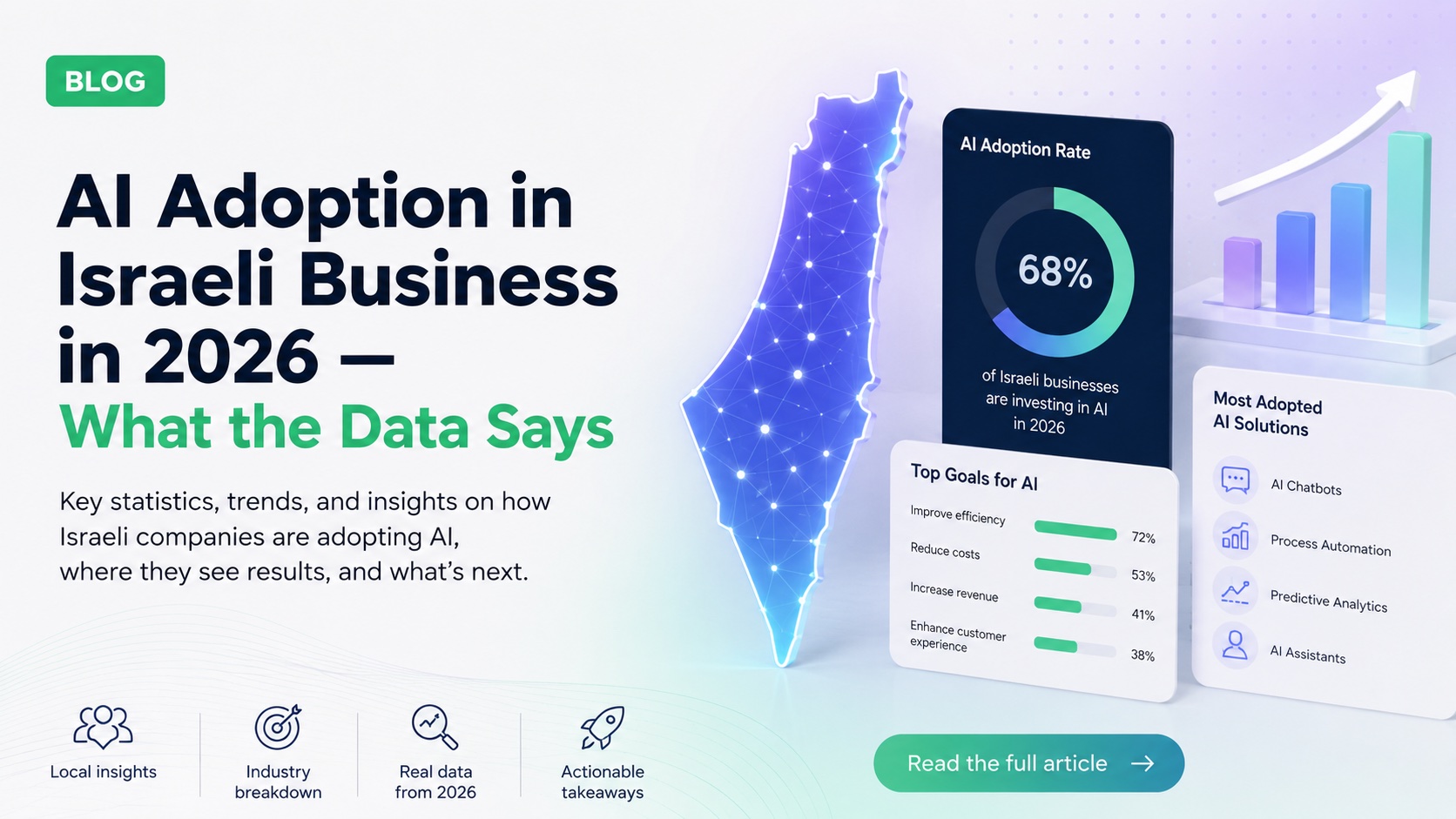
In 2026, the AI-for-business market in Israel is at a turning point. According to the Israeli Central Bureau of Statistics (April 2026), the share of Israeli businesses integrating AI into their workflows jumped from 28% to 39% in about 10 months. At the same time, 21% of businesses already report using AI to replace manual work that employees used to do.
This is a proven demand niche, not a passing trend. But the headline numbers are only part of the story.
The Geographic Gap You Cannot Ignore
The truly interesting figure is not the national average. The Israeli market is split geographically:
- Tel Aviv and the center: roughly 41% AI adoption among businesses
- Jerusalem and the periphery: roughly 4%
That is not a gap, it is a chasm. For service providers, the practical takeaway is simple: product–market fit sits in the center, not in “Israel in general.” A conservative recommendation for the validation period — point your marketing budgets and metrics at the hot demand zones, do not spread them thin across the whole country.
Which Roles Are Actually Being Replaced
The “21% use AI to replace manual work” figure does not mean 21% layoffs. It means there are repetitive tasks already being done differently:
- First-touch responses on WhatsApp and chat — recurring questions about prices, hours, availability
- Appointment booking and scheduling — qualification, warm-up, routing to the right rep
- Logging and data entry into the CRM — call summaries, lead status updates
- Tier-1 support — information lookup, request routing, order status
What they share: they require business context (who the customer is, the history, the current offers), not just language. That is why generic SaaS providers struggle to deliver full value — what’s needed is an AI model combined with the specific business’s knowledge base and with its operational systems.
What This Means for an SMB
If you own a business in central Israel and you’re weighing whether to move now, there are three practical questions:
1. Which repetitive process recurs every week and “hurts”?
If it’s appointment booking at a clinic — there’s a specific solution. If it’s customer support for an online store — there’s a different one. Don’t start from “a bot,” start from a process.
2. Where does your data live today?
CRM? Google Sheets? A notebook? Automation quality is directly tied to data accessibility. Integrating WhatsApp Business with a CRM is usually the minimum required.
3. How many hours will your team free up per week — and what will they do instead?
The goal of automation is to free time for higher-value work, not to cut headcount. Before going live, decide in advance what your service team will do with the 5–10 weekly hours that open up.
The Risk That Still Exists
The data is positive — but it doesn’t guarantee that everyone launching AI in 2026 will succeed. Two main risks:
- Expectations vs. reality: customers sometimes expect “a bot that understands everything” and get a generic script. Expectation management plus a high-quality knowledge base are key.
- Over-reliance on a single vendor: AI tech is still evolving fast. Make sure your solution rests on open standards (WhatsApp Cloud API, interchangeable models) — not on a “black box.”
Summary
AI adoption in Israeli businesses grew 39% (relative) in under a year — but the growth is concentrated geographically in the center and in specific process types. For anyone hunting product–market fit today, the answer isn’t a jump to an off-the-shelf box and it isn’t limited DIY — it’s a turnkey AI built on the knowledge base of your specific business.
That is exactly our specialty at Autias. If you’d like to see what it looks like for your business — contact us and you’ll get a tailored demo within a week.
Sources: Israeli Central Bureau of Statistics, April 2026 [confidence: high]. Geographic gaps — CBS quarterly surveys [confidence: high].