
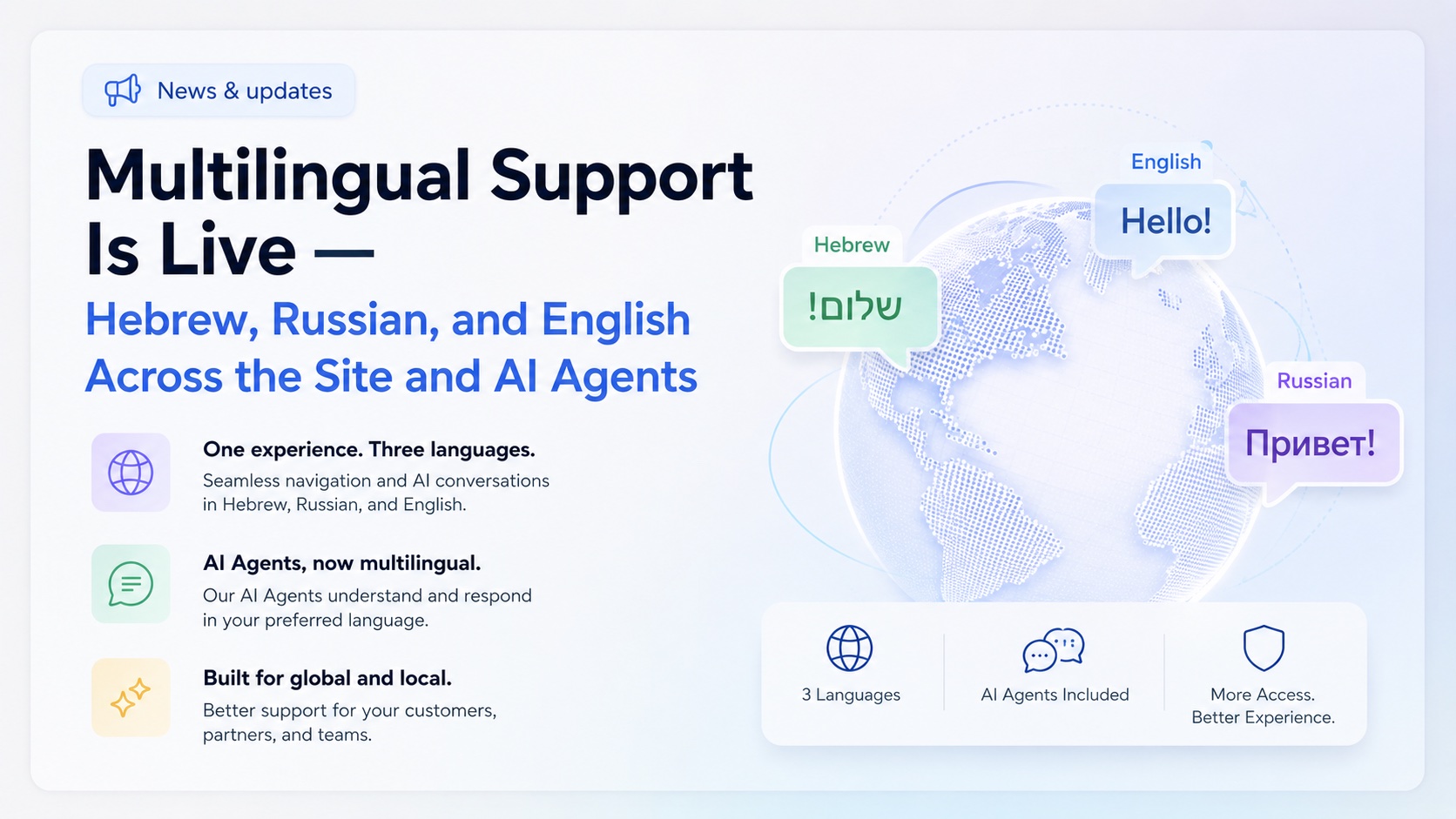
We’re glad to announce that today, Autias’s multilingual support is going live officially. The website, the AI agents, the service, and the lead-capture forms are now available in:
- Hebrew (HE) — the local language, full RTL layout
- Russian (RU) — dedicated support for the Russian- audience
- English (EN) — for new immigrants, international entrepreneurs, and B2B clients
Why It Matters — The Underserved Segments in the Market
Our research on the market in 2026 surfaced something interesting: Russian- and English-speaking audiences get lower-quality service in automation and AI agents, simply because most local providers ship Hebrew-only solutions.
In practice:
- Searching “chatbot for business” in Russian returns Russian providers from the Russian Federation, most of them irrelevant
- Searching for English solutions returns global providers that don’t support the WhatsApp Cloud API via phone numbers
- Native-language customer service is a critical trust factor, especially for SMBs
That gap is our opportunity — and the pain we solve.
What This Means in Practice
Anyone interested in our service, or already working with us, can:
- Get a quote and spec in their language — Hebrew, Russian, or English
- Choose the interface language of the AI agent that serves their end customers — meaning your customers also benefit from a 3-language agent
- Receive technical support and updates in their preferred language
- Read our blog and service descriptions in all three languages
Why It’s Right for You
If you run a business whose customers speak more than one language — for example:
- A clinic whose patients include Russian speakers or tourists — see the clinics vertical
- An online store with customers from outside — see the e-commerce vertical
- A law firm or accounting office with immigrant clients — see the professional services vertical
- A marketing agency or B2B firm working with international clients — see the agencies vertical
The agent we build will identify the language of the incoming message and respond in it automatically — no manual setting needed from the customer.
The Tools Behind the Scenes
We didn’t take the machine-translation shortcut. Every Hebrew, Russian, and English page on the site is written for that audience, not word-for-word translated. The same applies to our AI agents — the knowledge base is loaded separately in each language, so no nuance gets lost.
What’s Next
If you want to check whether multilingual support is relevant for your business — book an initial consultation and we’ll explain what it looks like for you.